
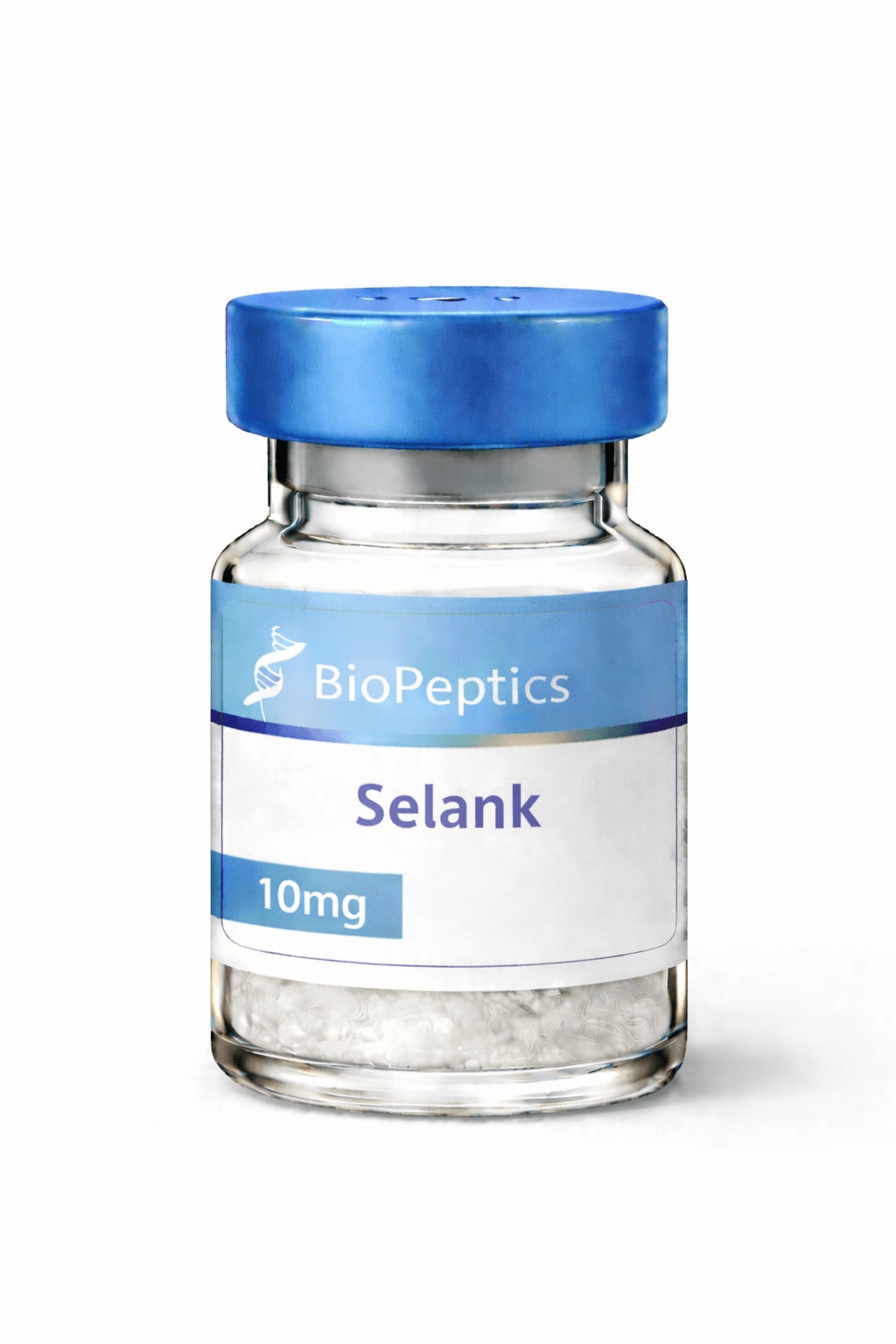

Selank 10mg (Heptapeptide Neuropeptide Analogue) Cognitive & Neurological Research Peptide
R 1,000.00
Selank is a synthetic peptide analogue derived from the naturally occurring immunomodulatory peptide tuftsin and is widely researched for its potential interaction with stress-response regulation, anxiolytic-related signaling, cognitive-performance pathways, and neuroregulatory mechanisms.
Unlike traditional sedative or stimulant-based compounds, Selank is commonly investigated in research involving neurotransmitter modulation, emotional-regulation pathways, neuroplasticity, stress adaptation, and cognitive-function signaling.
Research Applications
Research involving Selank commonly explores its potential interaction with:
- Stress-response and resilience-related pathways
- GABAergic and neurotransmitter-related signaling
- Cognitive-performance and focus-related pathways
- Emotional-regulation and neuroendocrine signaling
- Neuroplasticity and neuroprotective research
- Mental-fatigue and cognitive-endurance studies
Many individuals researching Selank report:
- Stress-response–related observations
- Calmness- and emotional-regulation–related observations
- Enhanced focus and cognitive-clarity observations
- Stress-resilience–related observations
- Cognitive-performance and mental-endurance–related observations
Because Selank is researched for its interaction with neuroregulatory and neurotransmitter pathways, it is often investigated alongside compounds such as:
- Semax
- NAD+
- Nootropic-support research peptides
These combination protocols are commonly explored in cognitive- and neurorecovery-focused experimental models.
Responses and tolerability observations may vary depending on:
- Research amount
- Administration frequency
- Neurochemical sensitivity
- Stress levels
- Sleep quality
- Overall physiological status
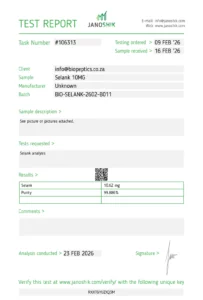
At BioPeptics, Selank is supplied in sterile lyophilized vial form for enhanced stability and is independently third-party tested for identity and purity verification.
For Research Use Only
Not intended to diagnose, treat, cure, or prevent any disease.
In stock
Selank
Selank is a synthetic peptide analogue derived from tuftsin, a naturally occurring immunomodulatory peptide. It is commonly researched for its potential interaction with neuroregulatory, stress-response, neurotransmitter, and cognitive-performance pathways.
Research involving Selank frequently investigates its potential interaction with:
- GABAergic neurotransmitter signaling
- Stress-response and resilience-related pathways
- Neuroendocrine regulation
- Cognitive-performance and focus-related signaling
- Emotional-regulation pathways
- Neuroplasticity and neuroprotective research
Unlike traditional sedative or stimulant-based compounds, Selank is researched for its broader neuroregulatory and neuromodulatory research profile involving neurotransmitter modulation, stress adaptation, cognitive-performance pathways, and neuroplasticity-related signaling.
Experimental models commonly investigate Selank in:
- Stress-response and resilience research
- Cognitive-performance and focus-related studies
- Mental-fatigue and cognitive-endurance models
- Neurorecovery and neuroprotective research
- Emotional-regulation and neuroendocrine pathways
Research also commonly explores Selank alongside compounds such as:
- Semax
- NAD+
- Noopept
- Neuroregulatory and nootropic research peptides
These combination protocols are investigated for complementary cognitive-performance, neuroregulatory, stress-response, and neuroprotective signaling pathways.
At BioPeptics, Selank is supplied in sterile lyophilized vial form for enhanced stability and is independently third-party tested for identity and purity verification.
For Research Use Only
Not intended to diagnose, treat, cure, or prevent any disease.
Research Applications
Stress-Response & Resilience Research
Selank is widely researched for its potential interaction with stress-response regulation and resilience-related pathways.
Research models commonly investigate:
- Stress-adaptation signaling
- Neuroendocrine-response pathways
- Resilience-focused cognitive models
- Mental-fatigue and recovery-related signaling
- Stress-related neuroregulatory mechanisms
Cognitive-Performance & Focus Research
Research involving Selank frequently explores its potential interaction with:
- Cognitive-performance and attention-related pathways
- Focus and concentration signaling
- Mental-endurance and productivity-related research
- Cognitive-workload adaptation models
- Task-engagement and executive-function pathways
Neurotransmitter & GABAergic Research
Because Selank is researched for its interaction with neurotransmitter pathways, experimental models commonly investigate:
- GABAergic signaling pathways
- Dopaminergic and serotonergic activity
- Neurochemical-regulation mechanisms
- Emotional-regulation and stress-response signaling
- Neurotransmitter-balance research
Neuroprotective & Neuroplasticity Research
Selank is also commonly researched in models involving:
- Neuroprotective signaling
- Neuroplasticity and neural-adaptation pathways
- Recovery-focused neuroscience models
- Cognitive-recovery and neuroregulatory research
- Brain-function and neuroregulatory studies
Mental-Fatigue & Cognitive-Endurance Research
Experimental models frequently investigate Selank in:
- Mental-fatigue and resilience studies
- Cognitive-endurance pathways
- Stress-related cognitive-performance research
- High-demand cognitive-workload models
- Neuroadaptation and recovery-focused protocols
Emotional-Regulation & Neuroendocrine Research
Research involving Selank commonly explores:
- Emotional-regulation pathways
- Stress-related neuroendocrine signaling
- Cortisol-related stress-response research
- Mood-related neuroregulatory mechanisms
- Behavioral-adaptation studies
Combination Nootropic & Neuroregulatory Research
Selank is frequently researched alongside:
- Semax
- NAD+
- Noopept
- Neuroregulatory and nootropic research peptides
These combination protocols are investigated for complementary:
- Cognitive-performance pathways
- Stress-response signaling
- Neuroprotective pathways
- Neuroplasticity-related signaling
- Neurotransmitter-related pathways
For Research Use Only
Not intended to diagnose, treat, cure, or prevent any disease.
Synergistic Research Applications
Selank is frequently researched alongside complementary nootropic, neuroregulatory, and neuroprotective compounds due to its broad stress-response and cognitive-performance research profile.
In experimental settings, combination protocols are commonly investigated for their potential interaction with:
- Neurotransmitter modulation
- Neuroplasticity-related signaling
- Cognitive-endurance pathways
- Emotional-regulation mechanisms
- Stress-response signaling
- Neuroregulatory pathways
With Semax
One of the most commonly researched combinations involves Selank and Semax.
Selank is commonly investigated for stress-response regulation, emotional-regulation pathways, and GABAergic signaling, while Semax is researched for cognitive-performance, focus-related, and neurotrophic pathways.
Research models explore whether this combination may influence:
- Focus and cognitive-performance signaling
- Stress-resilience and neuroregulatory pathways
- Neuroplasticity and neuroprotective signaling
- Mental-endurance and cognitive-workload adaptation
- Neurotransmitter-regulation pathways
With NAD+
Selank is also frequently researched alongside NAD+ in cognitive-performance and neurorecovery-focused protocols.
These combinations are investigated for complementary roles involving:
- Cellular-energy and mitochondrial-function pathways
- Stress-response and neuroprotective signaling
- Mental-performance and cognitive-endurance research
- Neurorecovery and neuroregulatory pathways
- Cognitive-workload adaptation models
With Noopept & Nootropic Research Compounds
Research involving Selank commonly explores combinations with:
- Noopept
- Racetam-related compounds
- Cholinergic-support research compounds
- Neuroregulatory peptides
These protocols investigate complementary:
- Cognitive-performance pathways
- Neurotransmitter-regulation signaling
- Memory-related pathways
- Neuroplasticity-related signaling
With Neurorecovery & Stress-Response Research Models
Because Selank is researched for its interaction with stress-response and neuroregulatory pathways, it is often included in broader neuroscience-focused protocols investigating:
- Stress-adaptation and resilience pathways
- Cognitive-endurance signaling
- Emotional-regulation mechanisms
- Neuroprotective and recovery-focused pathways
- Neuroplasticity and neural-adaptation research
Neuroregulatory Research Profile
Unlike traditional anxiolytic or stimulant-based compounds, Selank is researched for its broader neuroregulatory and neuromodulatory signaling profile involving:
- Neurotransmitter modulation
- Stress-response adaptation
- Cognitive-performance pathways
- Neuroplasticity-related signaling
For Research Use Only
Not intended to diagnose, treat, cure, or prevent any disease.
Technical Information
Compound Name:
Selank
Chemical Classification:
Synthetic Tuftsin-Derived Neuroregulatory Peptide
Composition
Selank is a synthetic peptide analogue derived from tuftsin, a naturally occurring immunomodulatory peptide.
It is commonly researched for its potential interaction with:
- Stress-response regulation
- Neurotransmitter modulation
- Cognitive-performance pathways
- Neuroregulatory signaling
Peptide Characteristics
- Synthetic tuftsin-derived peptide analogue
- Neuroregulatory and nootropic research peptide
- Commonly researched for stress-response and cognitive-performance pathways
- Investigated for GABAergic and neurotransmitter-related signaling
- Frequently studied in neuroplasticity and neuroprotective research models
Amino Acid Sequence:
Thr-Lys-Pro-Arg-Pro-Gly-Pro
Molecular Formula:
C₃₃H₅₇N₁₁O₉
Appearance:
White to off-white lyophilized powder
Solubility:
Water soluble
Research Category:
Nootropic and neuroregulatory research peptide
Common Research Areas
- Stress-response and resilience-focused research
- Cognitive-performance and focus-related studies
- Neurotransmitter and GABAergic signaling research
- Neuroplasticity and neuroprotective pathway investigations
- Mental-fatigue and cognitive-endurance models
- Emotional-regulation and stress-response research
Stability
Selank is typically supplied in lyophilized form to support peptide stability, purity, and long-term storage integrity during laboratory handling and research use.
For Research Purposes Only
Not intended to diagnose, treat, cure, or prevent any disease.
Selank (10mg) — Research Dosage Guidance
Stress-Response Research • Cognitive-Performance Research • Neuroregulatory Research
For Research Use Only
Reconstitution (Mixing)
- Add 2ml bacteriostatic water to the vial
- Inject slowly down the side of the vial
- Allow the peptide to dissolve naturally
- Swirl or roll gently if needed
- Do not shake the vial
- Protect from direct light
Storage Guidelines
- Lyophilized peptide: Store frozen at approximately −20°C when possible
- After reconstitution: Refrigerate at 2–8°C
- Do not refreeze after mixing
- Protect from excessive heat and direct sunlight
Concentration Guide
10mg mixed with 2ml bacteriostatic water provides an approximate concentration of:
- 5mg/ml
- Every 10 insulin units (0.1ml) ≈ 500mcg
- Every 1 insulin unit (0.01ml) ≈ 50mcg
Core Research Administration Guidelines
Commonly researched administration ranges include:
- Daily research range: 300–500mcg
- Frequency: Once daily
- Common administration method: Subcutaneous administration
Administration Considerations
- Maintain consistent administration timing when appropriate
- Rotate administration sites regularly
- Utilize sterile handling practices
Titration Protocol
Weeks 1–2 (Introductory Research Phase)
- Research amount: 300mcg daily
- Volume: 0.06ml
- U100 insulin syringe measurement: 6 units
Weeks 3–4 (Target Research Phase)
- Research amount: 500mcg daily
- Volume: 0.10ml
- U100 insulin syringe measurement: 10 units
Accuracy Note
For research amounts below 0.10ml, smaller-capacity insulin syringes may improve dosing precision in research settings.
Targeted Research Protocols
1. Stress-Response & Neuroregulatory Research
(Stress-response and GABAergic-signaling models)
- Research amount: 300mcg
- Frequency: Once daily
- Common timing: Morning or early afternoon
- Typical duration: 3–4 weeks
Research Notes
Lower-dose protocols are commonly researched in stress-response and neuroregulatory models.
2. Focus & Cognitive-Stability Research
(Attention, focus, and executive-function models)
- Research amount: 300–500mcg
- Frequency: Once daily
- Common timing: Morning
- Typical duration: 4 weeks
Research Notes
Frequently investigated in non-stimulant neuroregulatory and cognitive-performance research protocols.
3. Stress-Adaptation & Emotional-Regulation Research
(Stress-resilience and neuroendocrine-response models)
- Research amount: 500mcg
- Frequency: Once daily
- Common timing: Morning
- Typical duration: 4–6 weeks
Research Notes
Often investigated in broader cognitive-performance and neuroregulatory research protocols.
4. Neurorecovery & Cognitive-Recovery Research
(Mental-fatigue and neuroadaptation-focused models)
- Research amount: 300–500mcg
- Frequency: Once daily
- Typical duration: 4 weeks
Research Notes
Gradual titration protocols are commonly utilized in neurorecovery-focused research settings.
5. Maintenance & Long-Term Neuroregulatory Research
- Research amount: 300mcg
- Frequency: 3–5 days weekly
- Duration: Variable depending on research objectives
Research Notes
Lower-frequency protocols are commonly researched following full cognitive-performance cycles.
Cycle & Scheduling Options
- Standard cycle: Commonly researched as 4 weeks on / 4 weeks off
- Alternate schedule: 5 days on / 2 days off weekly
- Repeat cycles may vary depending on research objectives
Protocol Overview
| Category | Protocol |
|---|---|
| Purpose | Stress-response, focus, and cognitive-performance research |
| Daily range | 300–500mcg |
| Typical cycle | 4 weeks on / 4 weeks off |
| Concentration | 10mg mixed with 2ml = 5mg/ml |
| Administration | Once-daily subcutaneous administration |
Administration Guidance
- Clean vial and administration site with alcohol
- Draw research amount and remove air bubbles
- Administer slowly using sterile technique
- Rotate administration areas regularly
- Utilize a new sterile syringe for each administration
Important Research Notes
- Utilize sterile single-use administration equipment
- Store reconstituted peptide refrigerated at 2–8°C
- Protect from excessive heat and direct sunlight
- Do not shake after mixing
- Avoid repeated contamination of the vial during handling
For Research Use Only
Not intended to diagnose, treat, cure, or prevent any disease.
Possible Side Effects
Observed in Research Settings
Selank is generally regarded in research settings as a well-tolerated neuroregulatory peptide with a stress-response and cognitive-performance research profile.
Observed responses may vary depending on:
- Research amount
- Administration frequency
- Protocol duration
- Neurochemical sensitivity
- Individual physiological response
Commonly Reported Research Observations
- Mild headaches
- Temporary relaxation-related observations
- Mild drowsiness or fatigue in sensitive research models
- Temporary focus- or alertness-related observations
- Light-headedness
- Mild nausea or digestive discomfort
- Administration-site redness or irritation
Neuroregulatory & Neurotransmitter Research Considerations
Because Selank is researched for its interaction with GABAergic and neurotransmitter-related pathways, some research settings may observe:
- Variability in stress-response signaling
- Temporary mental-performance–related observations
- Altered focus or concentration-related observations
- Temporary mood-related observations
- Increased sensitivity in stimulant- or neurotransmitter-sensitive research models
Stress-Response & Neuroendocrine Research Considerations
Research involving Selank commonly investigates pathways associated with stress adaptation and neuroendocrine regulation.
Some experimental models may observe:
- Temporary wakefulness-pattern changes
- Variability in stress-resilience observations
- Temporary relaxation-related observations
- Individual variability in neuroregulatory response patterns
Administration & Handling Considerations
Improper storage, reconstitution, or administration techniques may increase the likelihood of:
- Administration-site irritation
- Local inflammation
- Reduced peptide stability
- Reduced compound integrity
Additional Research Notes
- Higher research amounts do not necessarily produce proportionally greater effects and may increase the likelihood of side effects
- Individual responses may vary depending on stress levels, sleep quality, concurrent nootropics or stimulants, and overall neurochemical sensitivity
- Combination protocols involving Semax, NAD+, Noopept, or other neuroregulatory compounds may influence overall cognitive and neurochemical response patterns
For Research Use Only
Not intended to diagnose, treat, cure, or prevent any disease.
Use With Caution in Research Contexts
Because Selank is researched for its interaction with neuroregulatory, neurotransmitter, GABAergic, and stress-response pathways, research involving complex neurological, mood-related, psychiatric, cardiovascular, or neuroendocrine conditions may warrant additional monitoring and individualized evaluation.
Additional Monitoring May Be Considered In Research Models Involving:
- Anxiety-spectrum or stress-response research models
- Neurological sensitivity or chronic migraines
- Sleep-related disorders or significant insomnia
- Mood-related or psychiatric conditions
- Dopaminergic or neurotransmitter-related sensitivity
- Hormonal or neuroendocrine-related disorders
- Cardiovascular or cardiometabolic-related conditions
- Multiple concurrent nootropic, stimulant, or neuroregulatory compounds
Carefully Evaluate Research Models With:
- Known hypersensitivity to peptide compounds
- Severe uncontrolled mood-related, psychiatric, or neurological conditions
- Severe uncontrolled cardiovascular disease
- Active severe systemic illness
- Pregnancy and breastfeeding research contexts
Additional Research Considerations
Because Selank may influence neurotransmitter, GABAergic, and stress-response signaling pathways, research protocols may warrant monitoring of:
- Sleep-quality and wakefulness-related observations
- Stress-response variability
- Mood-related observations
- Cognitive-performance and focus-related responses
- Overall individual tolerability and neuroregulatory response
Combination protocols involving Semax, NAD+, Noopept, stimulants, or other neuroregulatory compounds may further influence cognitive and neurochemical response patterns.
Important Notice
Selank is supplied strictly as a laboratory research compound and is not approved to diagnose, treat, cure, or prevent any disease.
For Research Use Only
Selank is a synthetic neuroregulatory peptide researched for its potential interaction with stress-response regulation, cognitive-performance pathways, emotional-regulation signaling, and neurotransmitter-related mechanisms.
Research involving Selank commonly investigates its potential role in:
- Stress-response and resilience-related pathways
- Cognitive-performance and focus-related signaling
- GABAergic and neurotransmitter-related mechanisms
- Emotional-regulation and neuroregulatory pathways
- Neuroplasticity and neuroprotective research
Observed responses in research settings are generally mild and may include:
- Temporary relaxation-related observations
- Mild drowsiness or fatigue in sensitive research models
- Temporary focus- or alertness-related observations
- Mild digestive discomfort
- Administration-site irritation
Responses may vary depending on:
- Research amount
- Administration frequency
- Protocol duration
- Neurochemical sensitivity
- Individual physiological response
Because Selank is researched for its interaction with neurotransmitter and stress-response pathways, research involving complex neurological, mood-related, psychiatric, or neuroendocrine conditions may warrant additional monitoring and individualized evaluation.
Proper reconstitution, sterile handling practices, consistent administration protocols, and appropriate dosing schedules are important for maintaining peptide stability and minimizing variability during research use.
For Research Use Only
Not intended to diagnose, treat, cure, or prevent any disease.
Be the first to review “Selank 10mg (Heptapeptide Neuropeptide Analogue) Cognitive & Neurological Research Peptide”
Related products



Reviews
There are no reviews yet.