

PT-141 10mg (Bremelanotide / Melanocortin Receptor Agonist) Melanocortin-Receptor Research Peptide
R 1,000.00
PT-141 (Bremelanotide) is a synthetic melanocortin receptor agonist peptide widely researched for its potential interaction with sexual-behavior pathways, arousal-related signaling, mood-related neuroregulatory mechanisms, and central nervous system melanocortin activity.
Unlike compounds that primarily influence vascular pathways, PT-141 is commonly investigated for its potential role in centrally mediated melanocortin signaling associated with arousal-related pathways, motivation-related signaling, neuroendocrine regulation, and behavioral-response research.
Research Applications
Research involving PT-141 commonly explores its potential interaction with:
- Melanocortin receptor signaling pathways
- Arousal-related neuroregulatory mechanisms
- Sexual-behavior and arousal-related research
- Dopaminergic and motivation-related signaling pathways
- Mood-related neuroendocrine research
- Central nervous system response pathways
Many individuals researching PT-141 report:
- Increased arousal-related observations
- Libido-related observations
- Arousal-related response observations
- Mood- and motivation-related observations
- Primarily centrally mediated rather than vascular-focused response pathways
Because PT-141 is researched for its interaction with melanocortin and neuroregulatory pathways, it is often investigated alongside compounds related to mood, neuroendocrine signaling, and arousal-related research models.
Responses and tolerability observations may vary depending on:
- Research amount
- Administration timing
- Neurochemical sensitivity
- Hormonal status
- Stress levels
- Overall physiological response
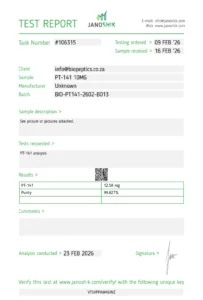
At BioPeptics, PT-141 is supplied in sterile lyophilized vial form for enhanced stability and is independently third-party tested for identity and purity verification.
For Research Use Only
Not intended to diagnose, treat, cure, or prevent any disease.
In stock
PT-141 (Bremelanotide)
PT-141 (Bremelanotide) is a synthetic melanocortin receptor agonist peptide researched for its potential interaction with central nervous system pathways involved in arousal-related signaling, sexual-behavior research, neuroendocrine regulation, and motivational neurochemistry.
Unlike compounds that primarily influence peripheral vascular pathways, PT-141 is commonly investigated for its central melanocortin receptor activity, particularly involving melanocortin receptor subtypes associated with behavioral, arousal-related, and neuroregulatory signaling pathways.
Research Applications
Research involving PT-141 frequently investigates its potential interaction with:
- Melanocortin receptor signaling pathways
- Arousal-related neuroregulatory mechanisms
- Motivation- and arousal-related signaling
- Dopaminergic and neurochemical pathways
- Mood- and neuroendocrine-related signaling interactions
- Central nervous system response pathways
Because PT-141 acts centrally rather than primarily through direct vascular mechanisms, experimental models commonly investigate its interaction with neuroregulatory and behavioral-response pathways related to arousal-related and motivational signaling.
Research involving PT-141 also explores:
- Neurochemical pathways associated with arousal-related signaling
- Mood- and neuroendocrine-related signaling interactions
- Behavioral-response and reward-related pathways
- Central melanocortin-system activity
PT-141 is frequently researched alongside compounds associated with:
- Neuroregulatory signaling
- Mood-related pathways
- Neuroendocrine and behavioral-response research
- Sexual-behavior and arousal-related models
Unlike traditional vascular-focused compounds, PT-141 is researched for its broader central neuroregulatory and melanocortin-related signaling profile involving arousal-related, motivational, and behavioral-response pathways.
For Research Use Only
Not intended to diagnose, treat, cure, or prevent any disease.
Research Applications
Sexual-Behavior & Arousal Research
PT-141 is widely researched for its potential interaction with sexual-behavior and arousal-related pathways.
Research models commonly investigate:
- Arousal-related neuroregulatory signaling
- Motivation- and behavioral-response pathways
- Behavioral-response mechanisms
- Sexual-behavior and responsiveness research
- Central melanocortin-system activity
Melanocortin Receptor Research
Because PT-141 functions as a melanocortin receptor agonist, experimental models commonly investigate:
- Melanocortin receptor signaling pathways
- Neuroendocrine and behavioral-response mechanisms
- Central nervous system melanocortin activity
- Neurochemical-regulation pathways
- Motivation- and reward-related signaling
Neuroregulatory & Dopaminergic Research
Research involving PT-141 frequently explores its potential interaction with:
- Dopaminergic signaling pathways
- Neurotransmitter-related mechanisms
- Motivation- and reward-related pathways
- Mood-related neuroregulatory signaling
- Central nervous system response models
Mood & Neuroendocrine Research
PT-141 is also commonly researched in models involving:
- Mood-related neuroendocrine pathways
- Stress-response and behavioral signaling
- Emotional-response regulation
- Neurochemical adaptation pathways
- Neuroregulatory and neuroendocrine research
Behavioral & Motivation Research
Experimental models commonly investigate PT-141 in:
- Behavioral-response studies
- Motivation-related signaling pathways
- Reward-system and neuroadaptation research
- Cognitive and behavioral-response interactions
- Neuroregulatory adaptation models
Combination Neuroregulatory Research
PT-141 is frequently researched alongside:
- Neuroregulatory peptides
- Dopaminergic and mood-related research compounds
- Neuroendocrine and behavioral-response research compounds
- Sexual-behavior and arousal-focused experimental models
These combination protocols are investigated for complementary:
- Melanocortin-related signaling
- Neuroregulatory pathways
- Motivational signaling
- Behavioral-response mechanisms
For Research Use Only
Not intended to diagnose, treat, cure, or prevent any disease.
Synergistic Research Applications
PT-141 (Bremelanotide) is frequently researched alongside complementary neuroregulatory, hormonal, and arousal-focused compounds due to its central melanocortin receptor activity and neuroendocrine research profile.
In experimental settings, combination protocols are commonly investigated for their potential interaction with:
- Arousal-related signaling
- Motivational pathways
- Mood-related neurochemistry
- Neuroendocrine regulation
- Behavioral-response mechanisms
- Neuroregulatory signaling
With Hormonal & Arousal-Focused Research Compounds
PT-141 is commonly researched alongside compounds involved in:
- Hormonal-regulation pathways
- Arousal-related signaling
- Neuroendocrine-response mechanisms
- Motivation- and behavioral-response research
Research models investigate whether these combinations may influence:
- Arousal-related neuroregulatory signaling
- Behavioral-response and arousal-related pathways
- Mood- and motivation-related mechanisms
- Central nervous system behavioral responses
With Dopaminergic & Neuroregulatory Research Compounds
Research involving PT-141 frequently explores combinations with compounds associated with:
- Dopaminergic signaling
- Neurotransmitter-regulation pathways
- Reward-system and motivational signaling
- Mood-related neuroregulatory research
These protocols investigate complementary neurochemical and behavioral-response pathways.
With Mood & Stress-Response Research Models
Because PT-141 is researched for its central melanocortin and neuroregulatory activity, it is often included in broader experimental models investigating:
- Mood-related neuroendocrine signaling
- Stress-response and behavioral pathways
- Emotional-regulation mechanisms
- Motivation- and reward-related signaling
- Central nervous system adaptation models
With Neuroregulatory Peptides
PT-141 is sometimes researched alongside:
- Semax
- Selank
- Neuroregulatory and nootropic research peptides
These combination protocols are investigated for complementary:
- Neurochemical pathways
- Motivational signaling
- Cognitive-response mechanisms
- Neuroregulatory pathways
Central Neuroregulatory Research Profile
Unlike compounds focused primarily on peripheral vascular pathways, PT-141 is researched for its broader central melanocortin and neuroregulatory signaling profile involving:
- Arousal-related pathways
- Motivational signaling
- Behavioral-response mechanisms
- Neuroendocrine pathways
For Research Use Only
Not intended to diagnose, treat, cure, or prevent any disease.
Technical Information
Compound Name:
PT-141 (Bremelanotide)
Chemical Classification:
Synthetic Melanocortin Receptor Agonist Peptide
Composition
PT-141 (Bremelanotide) is a synthetic peptide analogue derived from melanocortin-related peptide research.
It is commonly researched for its potential interaction with:
- Melanocortin receptor signaling
- Arousal-related neuroregulatory pathways
- Neuroendocrine mechanisms
- Central nervous system response pathways
Peptide Characteristics
- Synthetic melanocortin receptor agonist peptide
- Neuroregulatory and arousal-focused research peptide
- Commonly researched for central nervous system melanocortin activity
- Investigated for motivation-, behavioral-response-, and arousal-related pathways
- Frequently studied in neuroendocrine and dopaminergic research models
Amino Acid Sequence:
Ac-Nle-cyclo[Asp-His-D-Phe-Arg-Trp-Lys]-OH
Molecular Formula:
C₅₀H₆₈N₁₄O₁₀
Appearance:
White to off-white lyophilized powder
Solubility:
Water soluble
Research Category:
Neuroregulatory and melanocortin-signaling research peptide
Common Research Areas
- Sexual-behavior and arousal-related research
- Melanocortin receptor signaling studies
- Dopaminergic and motivational pathway investigations
- Mood-related neuroendocrine research
- Behavioral-response and reward-system models
- Central nervous system neuroregulatory studies
Stability
PT-141 is typically supplied in lyophilized form to support peptide stability, purity, and long-term storage integrity during laboratory handling and research use.
For Research Purposes Only
Not intended to diagnose, treat, cure, or prevent any disease.
PT-141 (10mg) — Research Dosage Guidance
Melanocortin Research • Neuroregulatory Research • Arousal-Related Pathway Research
For Research Use Only
Reconstitution (Mixing)
- Add 2ml bacteriostatic water to the vial
- Inject slowly down the side of the vial
- Allow the peptide to dissolve naturally
- Swirl or roll gently if needed
- Do not shake the vial
- Store reconstituted peptide refrigerated at 2–8°C
Concentration Guide
10mg mixed with 2ml bacteriostatic water provides an approximate concentration of:
- 5mg/ml
- Every 10 insulin units (0.1ml) ≈ 500mcg
- Every 1 insulin unit (0.01ml) ≈ 50mcg
Core Research Administration Guidelines
Commonly researched administration ranges include:
- Standard research range: 500mcg–2mg per administration
- Introductory research amount: 500mcg
- Higher-range research protocols: Up to 2mg
Common Administration Method
- Subcutaneous administration
Administration Considerations
- Maintain consistent administration timing when appropriate
- Rotate administration sites regularly
- Utilize sterile handling practices
Commonly Researched Timing
- Frequently researched approximately 45–60 minutes prior to the intended research observation window
Syringe Measurement Guide
| Research Amount | Volume | U100 Insulin Syringe Units |
|---|---|---|
| 250mcg | 0.05ml | 5 units |
| 500mcg | 0.10ml | 10 units |
| 1mg | 0.20ml | 20 units |
| 2mg | 0.40ml | 40 units |
Targeted Research Protocols
1. Introductory Arousal-Response Research
(Sensitivity assessment and response-profile models)
- Research amount: 500mcg
- Frequency: As needed according to research objectives
- Common timing: Approximately 45–60 minutes prior
Research Notes
Lower introductory protocols are commonly utilized to assess tolerability and individual response variability.
2. Standard Arousal & Behavioral-Response Research
(Arousal-related and behavioral-response models)
- Research amount: 1mg
- Frequency: As needed according to research objectives
- Common timing: Approximately 45–60 minutes prior
Research Notes
Commonly investigated in melanocortin and arousal-related neuroregulatory research models.
3. Advanced Melanocortin & Response-Pathway Research
(Advanced neuroregulatory and variable-response models)
- Research amount: 1.5–2mg
- Frequency: As needed according to research objectives
- Common timing: Approximately 45–60 minutes prior
Research Notes
Higher research amounts may increase the likelihood of flushing, nausea, or headache-related observations in sensitive research models.
4. Mood & Motivation Pathway Research
(Melanocortin-related mood and reward-signaling models)
- Research amount: 500mcg–1mg
- Frequency: 1–2 times weekly
- Common timing: Morning or early evening
Research Notes
Lower-dose protocols are commonly researched in mood-related neuroregulatory pathways.
5. Motivation & Neuroregulatory Research
(Motivation-related and behavioral-response pathways)
- Research amount: 500mcg–1mg
- Frequency: 1–2 times weekly
- Common timing: Morning administration
Research Notes
Commonly researched for central melanocortin and neuroregulatory signaling pathways.
Cycle & Frequency Guidelines
- Utilize according to research objectives
- Commonly researched no more than once within 24 hours
- Typical research frequency: 2–3 times weekly
- Allow at least 24 hours between administrations
Commonly Investigated Research Areas
- Melanocortin receptor signaling pathways
- Arousal-related neuroregulatory research
- Motivation- and reward-related pathways
- Neuroendocrine and behavioral-response signaling
- Central nervous system melanocortin activity
- Neuroregulatory research independent of nitric-oxide–focused vascular pathways
Important Research Notes
- Utilize sterile single-use administration equipment
- Store reconstituted peptide refrigerated at 2–8°C
- Protect from excessive heat and direct sunlight
- Do not shake after mixing
- Avoid repeated contamination of the vial during handling
Commonly Observed Dose-Related Research Observations
- Temporary flushing observations
- Mild nausea-related observations
- Temporary headache-related observations in sensitive research models
For Research Use Only
Not intended to diagnose, treat, cure, or prevent any disease.
Possible Side Effects
Observed in Research Settings
PT-141 (Bremelanotide) is generally regarded in research settings as a well-tolerated melanocortin receptor agonist peptide with a central neuroregulatory and arousal-related research profile.
Observed responses may vary depending on:
- Research amount
- Administration timing
- Neurochemical sensitivity
- Protocol structure
- Individual physiological response
Commonly Reported Research Observations
- Temporary flushing or warmth-related observations
- Mild nausea-related observations
- Headache-related observations
- Temporary arousal-related observations
- Temporary mood- or motivation-related observations
- Mild fatigue or light-headedness
- Administration-site redness or irritation
Melanocortin & Neuroregulatory Research Considerations
Because PT-141 is researched for its interaction with melanocortin and neuroregulatory pathways, some research settings may observe:
- Variability in behavioral-response signaling
- Temporary appetite-related observations
- Altered mood-related neurochemical responses
- Temporary wakefulness- or alertness-related observations
- Individual variability in neuroregulatory response patterns
Cardiovascular & Vascular Research Considerations
Although PT-141 is not primarily researched for direct vascular mechanisms, some experimental models may observe:
- Temporary blood-pressure variability
- Mild heart-rate–related observations
- Temporary flushing-related vascular observations
Administration & Handling Considerations
Improper storage, reconstitution, or administration techniques may increase the likelihood of:
- Administration-site irritation
- Local inflammation
- Reduced peptide stability
- Reduced compound integrity
Additional Research Notes
- Higher research amounts may increase the likelihood of nausea-, flushing-, or headache-related observations
- Individual responses may vary depending on hormonal status, stress levels, concurrent neuroregulatory compounds, and overall physiological sensitivity
- Combination protocols involving neuroregulatory, hormonal, or mood-related compounds may influence overall melanocortin and neurochemical response patterns
For Research Use Only
Not intended to diagnose, treat, cure, or prevent any disease.
Use With Caution in Research Contexts
Because PT-141 (Bremelanotide) is researched for its interaction with melanocortin, neuroregulatory, behavioral-response, and neuroendocrine pathways, research involving complex cardiovascular, neurological, hormonal, mood-related, or neurochemical conditions may warrant additional monitoring and individualized evaluation.
Additional Monitoring May Be Considered In Research Models Involving:
- Cardiovascular or significant cardiometabolic-related conditions
- Blood-pressure regulation sensitivity
- Mood-related or psychiatric conditions
- Neurological sensitivity or chronic migraines
- Hormonal or neuroendocrine-related disorders
- Dopaminergic or neurotransmitter-related sensitivity
- Sleep-related disorders or significant insomnia
- Multiple concurrent neuroregulatory, hormonal, or stimulant-related compounds
Carefully Evaluate Research Models With:
- Known hypersensitivity to peptide compounds
- Severe uncontrolled cardiovascular disease
- Severe uncontrolled mood-related, psychiatric, or neurological conditions
- Active severe systemic illness
- Pregnancy and breastfeeding research contexts
Additional Research Considerations
Because PT-141 may influence melanocortin, neuroregulatory, and behavioral-response signaling pathways, research protocols may warrant monitoring of:
- Blood-pressure and cardiovascular-response variability
- Mood- and motivation-related observations
- Wakefulness- and neurochemical-response patterns
- Arousal-related and behavioral-response signaling
- Overall individual tolerability and neuroregulatory response
Combination protocols involving neuroregulatory, hormonal, or mood-related compounds may further influence melanocortin and neurochemical response pathways.
Important Notice
PT-141 (Bremelanotide) is supplied strictly as a laboratory research compound and is not approved to diagnose, treat, cure, or prevent any disease.
For Research Use Only
Summary
PT-141 (Bremelanotide) is a synthetic melanocortin receptor agonist peptide widely researched for its potential interaction with arousal-related signaling, melanocortin receptor pathways, neuroregulatory mechanisms, motivational signaling, and central nervous system neuroendocrine activity.
Research involving PT-141 commonly investigates its potential role in melanocortin receptor (MC3R & MC4R) signaling, arousal-related neuroregulatory pathways, behavioral-response models, mood- and motivation-related neurochemistry, and central nervous system response mechanisms. Its central melanocortin and neuroregulatory research profile has contributed to growing interest across neuroregulatory, behavioral-response, and arousal-focused experimental models.
Observed side effects in research settings are generally mild and may include temporary flushing, nausea, headaches, temporary changes in mood or arousal-related perception, light-headedness, or administration-site irritation depending on research amount, administration timing, protocol structure, and individual physiological sensitivity.
Because PT-141 is researched for its interaction with melanocortin, neuroregulatory, and neuroendocrine pathways, research involving complex cardiovascular, neurological, mood-related, psychiatric, or hormonal conditions may warrant additional monitoring and individualized evaluation.
Proper reconstitution, sterile handling practices, consistent administration protocols, and appropriate dosing schedules are important for maintaining peptide stability and minimizing variability during research use.
For Research Use Only
Not intended to diagnose, treat, cure, or prevent any disease.
Be the first to review “PT-141 10mg (Bremelanotide / Melanocortin Receptor Agonist) Melanocortin-Receptor Research Peptide”
Related products





Reviews
There are no reviews yet.