
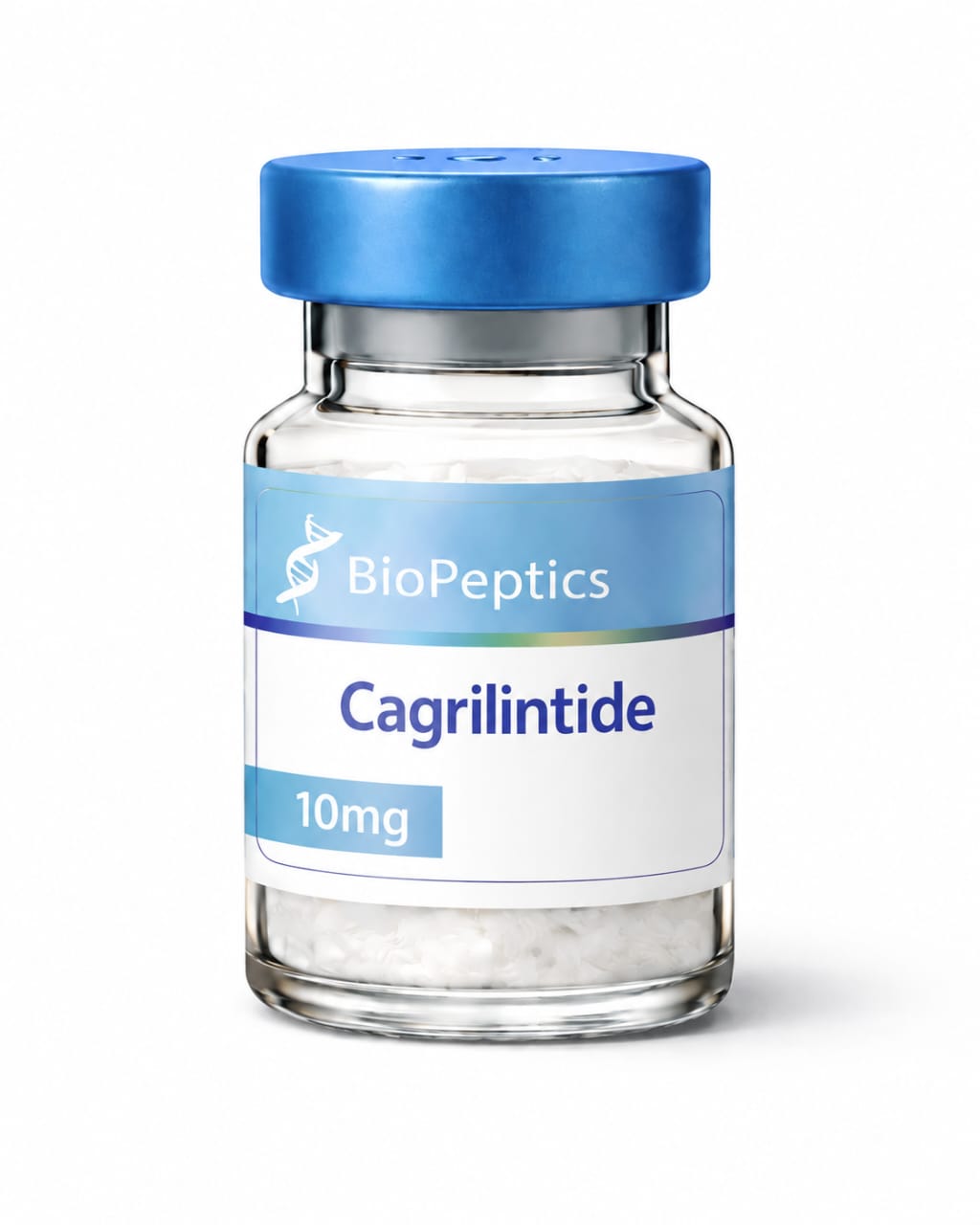
Cagrilintide 10 mg – Amylin Analogue for Appetite & Weight Management
R 2,000.00
Cagrilintide 10 mg
Long-Acting Amylin Analogue | Appetite, Satiety & Body Weight Research
Cagrilintide is a long-acting amylin analogue peptide currently being researched for its potential effects on appetite regulation, satiety, food intake, and body weight management.
Unlike GLP-1 receptor agonists such as semaglutide, or multi-receptor compounds such as tirzepatide and retatrutide, Cagrilintide primarily targets the amylin pathway.
Amylin is a naturally occurring hormone released by the pancreas alongside insulin after eating. It forms part of the body’s natural appetite-regulation system and contributes to signalling fullness and controlling food intake.
Cagrilintide has been engineered to provide prolonged amylin activity, allowing it to be investigated as a once-weekly compound in clinical research.
Cagrilintide is being researched for its potential role in:
• Appetite and hunger regulation
• Increased satiety and feelings of fullness
• Reduced food intake
• Body weight management
• Metabolic and obesity research
A Different Pathway to GLP-1
Cagrilintide is not a GLP-1 receptor agonist.
This distinction is important. While GLP-1 compounds act primarily through GLP-1 signalling, Cagrilintide works through amylin receptor pathways involved in the body’s regulation of appetite and satiety.
Because these pathways are different but potentially complementary, researchers are studying Cagrilintide both independently and in combination with GLP-1 receptor agonists.
Cagrilintide + Semaglutide Research
Cagrilintide is also being investigated together with semaglutide in the investigational combination known as CagriSema.
This combination targets two distinct pathways:
• Cagrilintide – amylin pathway
• Semaglutide – GLP-1 pathway
Research is investigating whether simultaneously targeting these pathways may produce complementary effects on appetite, satiety, food intake, and body weight.
Cagrilintide has also been studied as a standalone compound, making it distinct from CagriSema.
Individual Response
Responses and tolerability may vary significantly between individuals. Factors such as dose, consistency, nutrition, lifestyle, metabolic health, hormonal factors, sleep, and activity levels may influence individual outcomes.
Research Use Only
Cagrilintide is an investigational compound. Not intended to diagnose, treat, cure, or prevent any disease.
How It Works
Cagrilintide is a long-acting amylin analogue designed to mimic the activity of the naturally occurring hormone amylin.
Amylin is normally released alongside insulin after eating and contributes to the body’s natural regulation of appetite, satiety and food intake.
Cagrilintide activates amylin receptor pathways involved in appetite and satiety signalling, which is being researched for its potential to:
• Increase feelings of fullness and satiety
• Reduce hunger and overall food intake
• Support appetite regulation
• Contribute to body weight management
Unlike GLP-1 receptor agonists, Cagrilintide works through the amylin pathway, providing a distinct mechanism that is also being researched in combination with GLP-1–based compounds.
Research Applications
Cagrilintide is currently being investigated across several areas of metabolic and weight-management research, with particular interest in the role of amylin signalling in appetite, satiety and energy balance.
Current and emerging research applications include:
• Appetite and satiety regulation – investigating how amylin receptor activation influences hunger, fullness and meal termination
• Food intake research – studying its potential effects on reducing overall energy intake
• Body weight management – evaluating changes in body weight and body composition over time
• Obesity research – exploring long-acting amylin analogues as a potential approach to obesity management
• Metabolic health research – investigating broader metabolic effects associated with changes in body weight and energy balance
• Combination peptide research – particularly the complementary effects of Cagrilintide and GLP-1 receptor agonists such as semaglutide
• Amylin receptor research – studying the role of amylin signalling pathways in appetite control and body-weight regulation
Cagrilintide has been studied both as a standalone compound and in combination with semaglutide (CagriSema), providing researchers with an opportunity to investigate amylin-based mechanisms independently as well as alongside GLP-1 signalling.
Research remains ongoing, and Cagrilintide is considered an investigational compound.
For Research Use Only.
Synergistic Effect
Cagrilintide is being researched for its potential complementary effects when combined with GLP-1 receptor agonists, particularly semaglutide.
The two compounds act through different pathways:
• Cagrilintide targets amylin receptor pathways involved in appetite and satiety regulation.
• Semaglutide activates GLP-1 receptors involved in appetite, food intake and glucose regulation.
By targeting both amylin and GLP-1 signalling, researchers are investigating whether the combination may provide greater effects on satiety, appetite regulation, food intake and body weight than either pathway alone.
This combination is known as CagriSema and is currently being investigated in clinical research.
Cagrilintide can also be studied independently as a standalone amylin analogue.
For Research Use Only.
Composition
Each vial contains:
• Cagrilintide – 10 mg
• Form: Lyophilised (freeze-dried) peptide
• Presentation: Single research vial
• Appearance: Lyophilised powder
Cagrilintide is a long-acting amylin analogue developed for research into amylin receptor signalling, appetite regulation, satiety and body-weight management.
For Research Use Only.
Cagrilintide (10 mg) — Research Dosage Guidance
Amylin Research • Appetite-Regulation Studies • Satiety Research • Body-Weight Research
Reconstitution (Mixing)
For a research preparation using 3 ml:
- Add 3 ml bacteriostatic water to the 10 mg vial
- Inject the water slowly down the side of the vial
- Allow the lyophilised peptide to dissolve naturally
- Swirl gently if needed
- Do not shake
- Store according to the product’s validated storage requirements
Concentration Calculation
10 mg ÷ 3 ml = 3.33 mg/ml
Using a U-100 insulin syringe:
- Every 1 insulin unit (0.01 ml) ≈ 0.0333 mg / 33.3 mcg
- 9 units = 0.3 mg
- 18 units = 0.6 mg
- 36 units = 1.2 mg
- 72 units = 2.4 mg
Clinical Research Dose Calculations
| Dose Investigated | Volume | U-100 Syringe Equivalent |
|---|---|---|
| 0.3 mg | 0.09 ml | 9 units |
| 0.6 mg | 0.18 ml | 18 units |
| 1.2 mg | 0.36 ml | 36 units |
| 2.4 mg | 0.72 ml | 72 units |
| 4.5 mg | 1.35 ml | 135 units total volume equivalent* |
4.5 mg corresponds mathematically to 1.35 ml when a 10 mg vial is reconstituted with 3 ml. This exceeds the capacity of a standard 1 ml U-100 syringe and is shown only as a concentration calculation.
Approximate Vial Equivalents
| Research Dose | Approximate Number of Doses per 10 mg Vial |
|---|---|
| 0.3 mg | ~33 doses |
| 0.6 mg | ~16 doses |
| 1.2 mg | ~8 doses |
| 2.4 mg | ~4 doses |
| 4.5 mg | ~2 doses |
Figures are mathematical equivalents and do not account for residual volume or handling losses.
Doses Investigated in Clinical Research
Published Phase 2 research investigated once-weekly Cagrilintide at the following target doses:
- 0.3 mg once weekly
- 0.6 mg once weekly
- 1.2 mg once weekly
- 2.4 mg once weekly
- 4.5 mg once weekly
The Phase 2 trial included 706 participants and a 26-week treatment period, with dose escalation of up to 6 weeks depending on the assigned target dose.
Clinical Research Protocols
1. 0.3 mg Research Group
- Target dose: 0.3 mg once weekly
- 10 mg + 3 ml calculation: 9 units
- Research duration: 26 weeks in the Phase 2 dose-finding trial
Research Notes
The 0.3 mg dose was one of the lower target doses investigated in the Phase 2 Cagrilintide monotherapy study.
2. 0.6 mg Research Group
- Target dose: 0.6 mg once weekly
- 10 mg + 3 ml calculation: 18 units
Research Notes
The 0.6 mg dose was investigated as a once-weekly target dose in the Phase 2 trial.
3. 1.2 mg Research Group
- Target dose: 1.2 mg once weekly
- 10 mg + 3 ml calculation: 36 units
Research Notes
Higher target-dose groups incorporated gradual dose escalation as part of the clinical research protocol.
4. 2.4 mg Research Group
- Target dose: 2.4 mg once weekly
- 10 mg + 3 ml calculation: 72 units
Published Phase 2 Escalation Example
For the 2.4 mg target-dose group, the registered Phase 2 protocol used:
- Week 0: 0.6 mg
- Week 2: 1.2 mg
- Week 4 onward: 2.4 mg
This is a description of the clinical-trial protocol and not an approved personal dosing schedule.
5. 4.5 mg Research Group
- Target dose: 4.5 mg once weekly
- 10 mg + 3 ml mathematical volume: 1.35 ml
Published Phase 2 Escalation Example
For the 4.5 mg target-dose group, the trial used:
- Week 0: 0.6 mg
- Week 2: 1.2 mg
- Week 4: 2.4 mg
- Week 6 onward: 4.5 mg
This was the highest target dose evaluated in the published Phase 2 dose-finding study.
Current Cagrilintide Research
Cagrilintide is a long-acting amylin analogue being investigated for weight management.
Research areas include:
- Appetite regulation
- Hunger and satiety signalling
- Food-intake regulation
- Body-weight regulation
- Obesity research
- Metabolic outcomes
- Safety and tolerability
- Dose-response relationships
Cagrilintide + Semaglutide Research
Cagrilintide has also been studied in combination with Semaglutide.
The investigational combination known as CagriSema combines two different mechanisms:
- Cagrilintide: long-acting amylin analogue
- Semaglutide: GLP-1 receptor agonist
Clinical research has investigated a target dose containing:
- Cagrilintide 2.4 mg
- Semaglutide 2.4 mg
The combination is being researched for complementary effects on appetite, satiety, food intake, metabolic outcomes and body weight.
Common Research Timing
- Once-weekly administration has been investigated
- Dose escalation has been incorporated into clinical trials
- The Phase 2 monotherapy study included a 26-week treatment period
- Escalation schedules differed according to the assigned target dose
Commonly Investigated Research Areas
- Amylin receptor signalling
- Appetite and hunger regulation
- Satiety
- Food-intake regulation
- Body-weight management
- Obesity research
- Body-composition research
- Metabolic research
- Dose-response research
- Combination research with GLP-1 receptor agonists
Important Research Notes
- Cagrilintide is a long-acting amylin analogue
- It is not a GLP-1 receptor agonist
- Cagrilintide remains an investigational compound
- There is currently no approved therapeutic dosing schedule for Cagrilintide
- The doses above are doses evaluated in clinical research
- The syringe calculations are based specifically on 10 mg reconstituted with 3 ml
- Clinical-trial protocols should not be interpreted as personal dosing recommendations
Research Use Only
Cagrilintide is an investigational research compound.
The dosing information above describes published clinical research and mathematical concentration equivalents for research reference.
Not intended to diagnose, treat, cure or prevent any disease.
Possible Side Effects (Observed in Research & Clinical Settings)
Cagrilintide has generally been reported as well tolerated in clinical research; however, side effects may occur and can vary depending on the individual and dose being studied.
The most commonly observed side effects have been gastrointestinal, particularly during dose escalation.
Commonly observed effects may include:
• Nausea
• Constipation
• Diarrhoea
• Vomiting
• Abdominal discomfort or abdominal pain
• Reduced appetite
• Feelings of increased fullness or early satiety
• Administration/injection-site reactions
Gastrointestinal effects have generally been reported as mild to moderate and may be more noticeable during dose escalation.
Because Cagrilintide is a long-acting amylin analogue, its safety profile should not automatically be assumed to be identical to that of GLP-1 receptor agonists such as Semaglutide or multi-receptor compounds such as Retatrutide.
Individual response and tolerability can vary, and Cagrilintide remains an investigational compound with ongoing clinical research evaluating its longer-term safety and tolerability.
Research Use Only
Not intended to diagnose, treat, cure or prevent any disease.
Cagrilintide research should be avoided or approached with particular caution in individuals who:
• Are pregnant, breastfeeding, planning pregnancy, or are of childbearing potential without appropriate contraception
• Have a known hypersensitivity or allergy to the compound or formulation components
• Have significant or unstable gastrointestinal disease
• Have significant kidney or liver impairment, unless specifically included and medically monitored within an appropriate research protocol
• Have significant or unstable cardiovascular disease or have recently experienced a major cardiovascular event
• Have a current or recent history of malignancy, where this would conflict with clinical research eligibility criteria
• Have diabetes or are using glucose-lowering medication, unless the specific research protocol is designed for participants with diabetes
• Are currently using another amylin analogue, GLP-1–based medication, weight-management medication or investigational compound, unless specifically permitted by the research protocol
• Have any significant medical condition that could increase risk or interfere with interpretation of research results
Pregnancy & Breastfeeding
Cagrilintide has not been established as safe during pregnancy or breastfeeding. Clinical trials exclude pregnant and breastfeeding participants, and pregnancy should therefore be considered an important exclusion in a research context.
Diabetes & Glucose-Lowering Medication
Cagrilintide research has included different study populations. Some studies exclude diabetes entirely, while other clinical trials specifically investigate Cagrilintide in people with type 2 diabetes.
For this reason, diabetes itself should not be described as a universal contraindication. The appropriate precautions depend on the specific research protocol and concomitant medication.
Important Research Note
Because Cagrilintide is still under clinical development, an established comprehensive contraindication list comparable with that of an approved medicine is not yet available.
Eligibility, medical history, concurrent medication and potential risks should therefore be evaluated according to the specific research protocol.
For Research Use Only.
Summary
Cagrilintide is a long-acting amylin analogue currently being investigated for its potential role in appetite regulation, satiety, food intake and body-weight management.
By activating amylin receptor pathways involved in hunger and satiety signalling, Cagrilintide provides a different mechanism of action from GLP-1 receptor agonists.
Clinical research has investigated Cagrilintide for:
• Appetite and hunger regulation
• Increased satiety and feelings of fullness
• Reduced food intake
• Body-weight management
• Obesity and metabolic research
• Dose-response and body-composition research
• Combination research with GLP-1 receptor agonists
Published clinical studies have investigated once-weekly Cagrilintide, including target doses ranging from 0.3 mg to 4.5 mg in Phase 2 research. Cagrilintide has demonstrated dose-dependent reductions in body weight in clinical trials.
Cagrilintide is also being studied alongside Semaglutide in the investigational combination known as CagriSema, targeting both the amylin and GLP-1 pathways.
The most frequently reported adverse effects in clinical research have been gastrointestinal, including nausea, constipation and diarrhoea, as well as administration-site reactions.
Cagrilintide remains an investigational compound, and its long-term safety, optimal dosing and therapeutic role continue to be evaluated in clinical research.
At BioPeptics, Cagrilintide 10 mg is supplied in lyophilised vial form.
Research Use Only
Not intended to diagnose, treat, cure or prevent any disease.


Reviews
There are no reviews yet.